

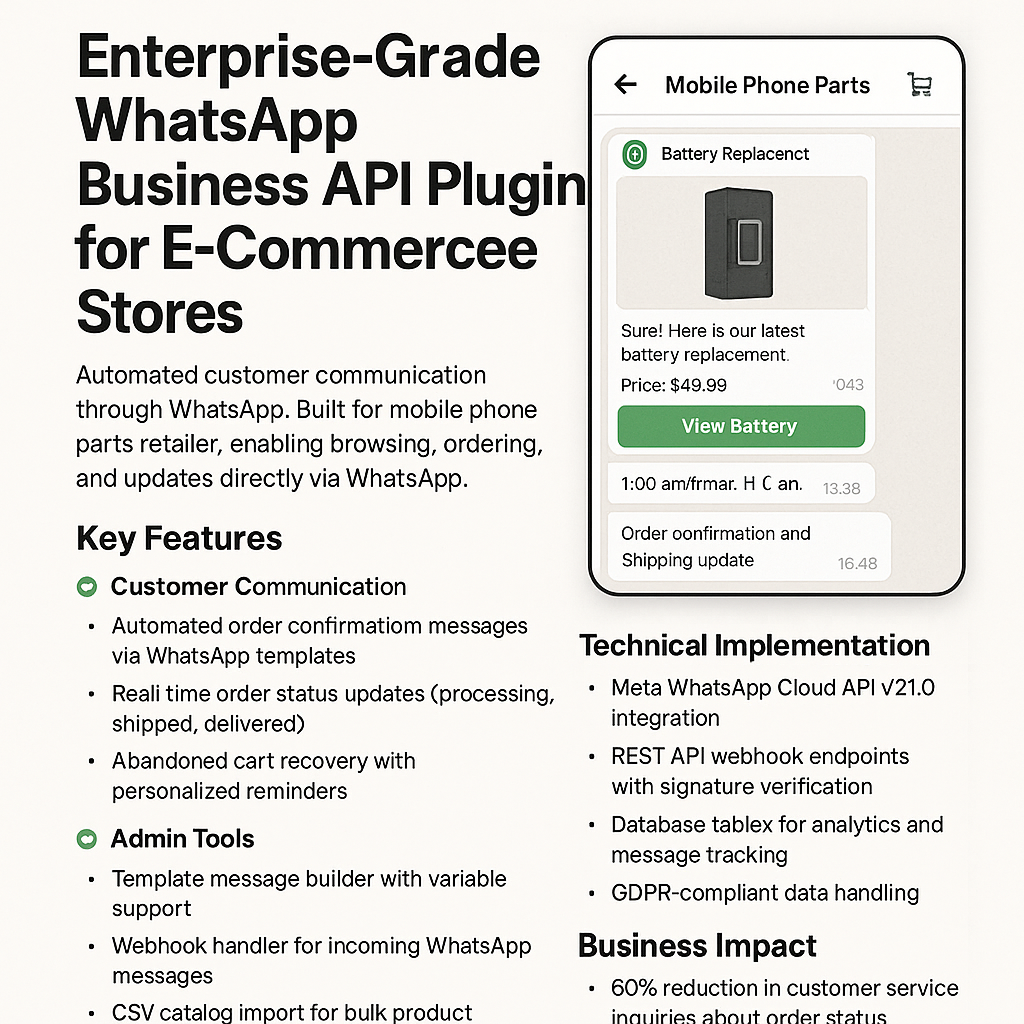
WhatsApp Business API Plugin for E-Commerce Stores
An enterprise-grade WhatsApp Business API integration built for an e-commerce mobile phone parts retailer, enabling automated customer communication, order updates, abandoned cart recovery, product sharing, and customer engagement directly through WhatsApp.
Project Description
This project is an enterprise-grade WhatsApp Business API integration for e-commerce stores, designed to automate customer communication through WhatsApp. Built for a mobile phone parts retailer, the plugin transforms the traditional e-commerce experience by allowing customers to browse products, place orders, receive order updates, and re-engage with abandoned carts directly through WhatsApp.
The platform automates the entire customer journey from order confirmation to shipping notifications, reducing customer service workload while providing a familiar and convenient communication channel for mobile-tech markets where WhatsApp is the dominant platform.
The solution was built as a custom WordPress and WooCommerce plugin using PHP, React.js, REST APIs, Meta WhatsApp Cloud API, webhook handling, database tracking, and automated messaging workflows.
Project Overview
The main objective was to create a WhatsApp-first customer communication layer for an e-commerce business. Instead of relying only on email updates, the store can communicate with customers through automated WhatsApp messages during key stages of the buying journey.
The plugin supports customer communication, admin-controlled message templates, real-time webhooks, delivery analytics, abandoned cart recovery, CSV catalogue import, and deep links for product sharing.
Key Features Built
Automated Order Confirmations
Customers receive automated WhatsApp order confirmation messages using approved WhatsApp message templates immediately after checkout.
Real-Time Order Status Updates
The plugin sends real-time WhatsApp updates for key order stages, including processing, shipped, and delivered.
Abandoned Cart Recovery
Customers who leave items in their cart receive personalised WhatsApp reminders, helping the business recover lost sales.
WhatsApp Chat Widget
A website-embedded WhatsApp chat widget was implemented using a shadow-DOM structure to avoid style conflicts with the active WordPress theme.
Template Message Builder
Admin users can create and manage WhatsApp message templates with variable support, allowing dynamic customer, order, and product data to be inserted automatically.
Webhook Handler
A webhook system was built to receive and process incoming WhatsApp messages, delivery receipts, and customer interactions through secure REST API endpoints.
CSV Catalogue Import
Admin users can import product catalogue data in bulk using CSV files, making it easier to prepare products for WhatsApp-based messaging and sharing.
Analytics Dashboard
Built an analytics dashboard to track message delivery rates, queue performance, customer responses, and campaign effectiveness.
Product Deep Linking
Implemented a deep linking system that allows products to be shared directly through WhatsApp with customer-friendly links.
Automated Messaging Queue
Added a cron-based automated messaging system for scheduled order updates, abandoned cart reminders, retries, and throttled message delivery.
Technical Implementation
Core Platform
- Custom WordPress plugin development
- WooCommerce integration
- PHP 8+
- React.js admin interface
- WordPress REST API
API and Automation
- Meta WhatsApp Cloud API v21.0
- REST API webhook endpoints
- Webhook signature verification
- Cron-based automated messaging
- Queue-based message throttling
Data and Compliance
- Database tables for analytics
- Message tracking storage
- GDPR-compliant data handling
- Delivery status logging
- Retry and failure tracking
Technical Challenges and Solutions
Challenge 1: Webhook Reliability
Meta webhook verification requires instant responses with specific challenge codes. WordPress plugin loading sequences can create timing issues and delay webhook verification.
Solution
I implemented direct REST API route registration in the main plugin file before other components loaded. This ensured webhook verification could happen immediately without dependency delays.
Challenge 2: Template Variable Management
WhatsApp templates require precise variable ordering and formatting, making it difficult for non-technical users to create valid message templates.
Solution
I built a visual template builder with variable insertion, automatic validation, preview functionality, and automatic mapping between WooCommerce order data and WhatsApp template variables.
Challenge 3: Rate Limiting and Message Throttling
Meta enforces strict message throughput limits, which can cause abandoned cart notifications and bulk updates to fail during peak traffic periods.
Solution
I implemented a queue-based messaging system with intelligent throttling, retry logic, exponential backoff, priority levels, and a monitoring dashboard for queue status and delivery performance.
Challenge 4: Theme Compatibility
WordPress themes can interfere with plugin frontend widgets, causing layout, styling, and JavaScript conflicts.
Solution
I used a shadow-DOM implementation for the WhatsApp chat widget to isolate styles and preserve consistent behaviour across different WordPress themes.
Business Impact
- Reduced customer service workload through automated WhatsApp order updates.
- Improved abandoned cart recovery using personalised WhatsApp reminders.
- Improved customer communication speed through a familiar mobile-first channel.
- Enabled admins to manage templates, messaging, analytics, and customer communication from one plugin interface.
- Created a scalable WhatsApp communication layer for WooCommerce-based e-commerce stores.
My Role
WordPress Plugin Developer and API Integration Lead
I designed and built the custom WordPress plugin architecture, integrated the Meta WhatsApp Cloud API, developed REST API webhook endpoints, implemented message tracking, created the admin tools, and built the automated messaging workflows.
I also handled the technical problem-solving around webhook reliability, template variable management, message throttling, GDPR-conscious data handling, and WooCommerce order lifecycle integration.

Leave A Comment