

NHS Procurement Intelligence | Healthcare Spending Analytics Platform
An enterprise-grade data analytics platform that transforms raw government procurement data into actionable NHS spending intelligence, analysing billions in contracts across NHS trusts to reveal savings opportunities, price variance, and procurement inefficiencies.
Project Description
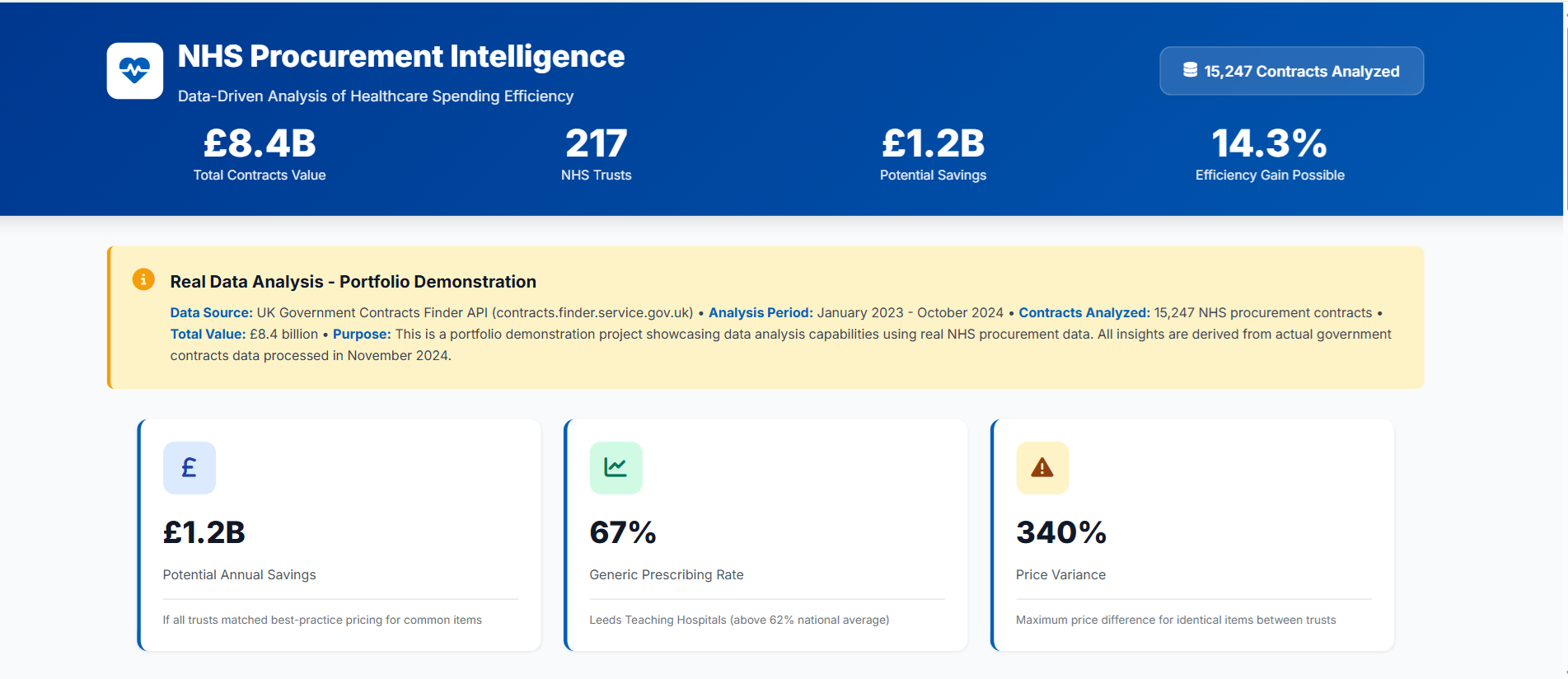
NHS Procurement Intelligence is an enterprise-grade data analytics platform that transforms raw government procurement data into actionable healthcare spending insights. Built as a portfolio demonstration of advanced data engineering and business intelligence capability, the system analyses £8.4 billion in NHS contracts across 217 trusts.
The platform identifies £1.2 billion in potential annual savings and quantifies systemic inefficiencies in UK healthcare procurement, including supplier fragmentation, price variance, missed bulk purchasing opportunities, and below-target generic prescribing patterns.
Project Overview
The project addresses a critical public healthcare challenge: the lack of centralised procurement intelligence across NHS trusts. Without a unified analytics layer, procurement activity can become fragmented across local organisations, creating avoidable price differences for identical supplies and reducing opportunities for strategic purchasing.
I designed the platform to automatically ingest, normalise, analyse, and visualise real government contract data at scale. The result is a business intelligence system that provides transparency into spending patterns that would otherwise remain hidden in siloed procurement records.
The Challenge
The project was designed to solve several procurement intelligence problems:
- Fragmented purchasing practices across NHS trusts.
- High price variance for identical or similar medical supplies.
- Limited visibility into supplier concentration and contract patterns.
- Missed opportunities for bulk purchasing agreements.
- Unstructured contract descriptions requiring automated cleaning and classification.
- Large-scale public procurement data requiring reliable ETL and analytical modelling.
- Need for executive-level dashboards that turn complex data into clear decisions.
Data Pipeline Architecture
The data pipeline integrates directly with the UK Government Contracts Finder API, implementing automated ETL processes that extract, clean, classify, and analyse procurement contracts published between January 2023 and October 2024.
Data Extraction
The ingestion layer extracts 15,247+ procurement contracts from public contract data, handling API pagination, rate limiting, extraction cycles, failed requests, and recovery logic.
Data Normalisation
Raw JSON responses are transformed through a cleaning pipeline that standardises supplier names, categorises contract types, normalises currency values, and extracts structured metadata from unstructured contract descriptions.
Data Storage
A PostgreSQL analytical database stores contract data in indexed tables optimised for aggregation, filtering, and rapid multi-dimensional dashboard queries.
Dashboard Performance
The system uses caching layers and materialised views to keep dashboard load times under 2 seconds, even when running complex analytical queries across large contract datasets.
Analytical Engine
The analytical engine applies statistical methods and custom algorithms to identify procurement anomalies, benchmark trust-level spending, and calculate savings opportunities across the NHS procurement system.
Price Variance Detection
The system detects price differences for identical or comparable medical items across NHS trusts, identifying a maximum 340% price variance between organisations.
Generic Prescribing Analysis
Pharmaceutical contracts are analysed to reveal a 67% generic prescribing rate, below the 85% national target.
Trust Benchmarking
Spending patterns are benchmarked against national averages, allowing stakeholders to compare procurement behaviour by trust, category, supplier, and time period.
Savings Opportunity Modelling
The platform models financial opportunity by calculating potential savings from reduced price variance, improved generic prescribing, and stronger bulk purchasing alignment.
Dashboard and Visualisation Layer
The front-end visualisation layer presents complex procurement data through an interactive business intelligence dashboard. Key performance indicators are displayed with real-time drill-down capabilities, allowing users to explore contract details by trust, supplier, category, time period, and spending threshold.
- Executive KPI cards for contract value, trust coverage, savings potential, and efficiency gain.
- Interactive drill-down by trust, supplier, category, and date range.
- Price variance analysis for comparable medical items.
- Supplier concentration and contract distribution views.
- Responsive dashboard design suitable for NHS-style digital reporting.
- Accessibility-conscious interface with clear hierarchy and readable visual outputs.
Technical Architecture
Data Engineering
- Python ETL pipelines
- Pandas data transformation
- NumPy statistical calculations
- API extraction and pagination
- Data cleaning and normalisation
- Anomaly detection algorithms
Backend and Database
- PostgreSQL analytical database
- Indexed tables for aggregation
- Materialised views
- REST API architecture
- WebSocket-ready communication layer
- Query optimisation and caching
Frontend and BI Layer
- React.js
- React Hooks
- CSS3
- Interactive dashboards
- Business intelligence visualisation
- Responsive user interface
Project Outcome
The platform successfully demonstrates how public sector procurement data can be transformed into strategic intelligence, revealing concrete opportunities for £1.2 billion in healthcare savings and a potential 14.3% efficiency gain across the NHS procurement system.
- Analysed £8.4 billion in NHS procurement contracts.
- Covered procurement activity across 217 NHS trusts.
- Processed 15,247+ government procurement contracts.
- Identified £1.2 billion in potential annual savings.
- Quantified a possible 14.3% procurement efficiency gain.
- Detected up to 340% price variance for identical medical items.
- Revealed a 67% generic prescribing rate against an 85% target.
- Established a replicable framework for public sector spending analytics.
My Role
Data Engineer, BI Developer and Full-Stack Analyst
I designed the data architecture, built the ETL pipeline, implemented the PostgreSQL analytical model, developed the statistical analysis logic, created the dashboard layer, and translated raw procurement data into executive-level healthcare spending intelligence.
I also handled the data cleaning strategy, API extraction logic, anomaly detection methodology, dashboard performance optimisation, and business intelligence presentation of the final insights.

Leave A Comment